Full Stack Software Engineer
Productivity as a New Form of Procrastination
On the kind of distraction that looks like work — and why building the system can take more time than the work the system was built for.
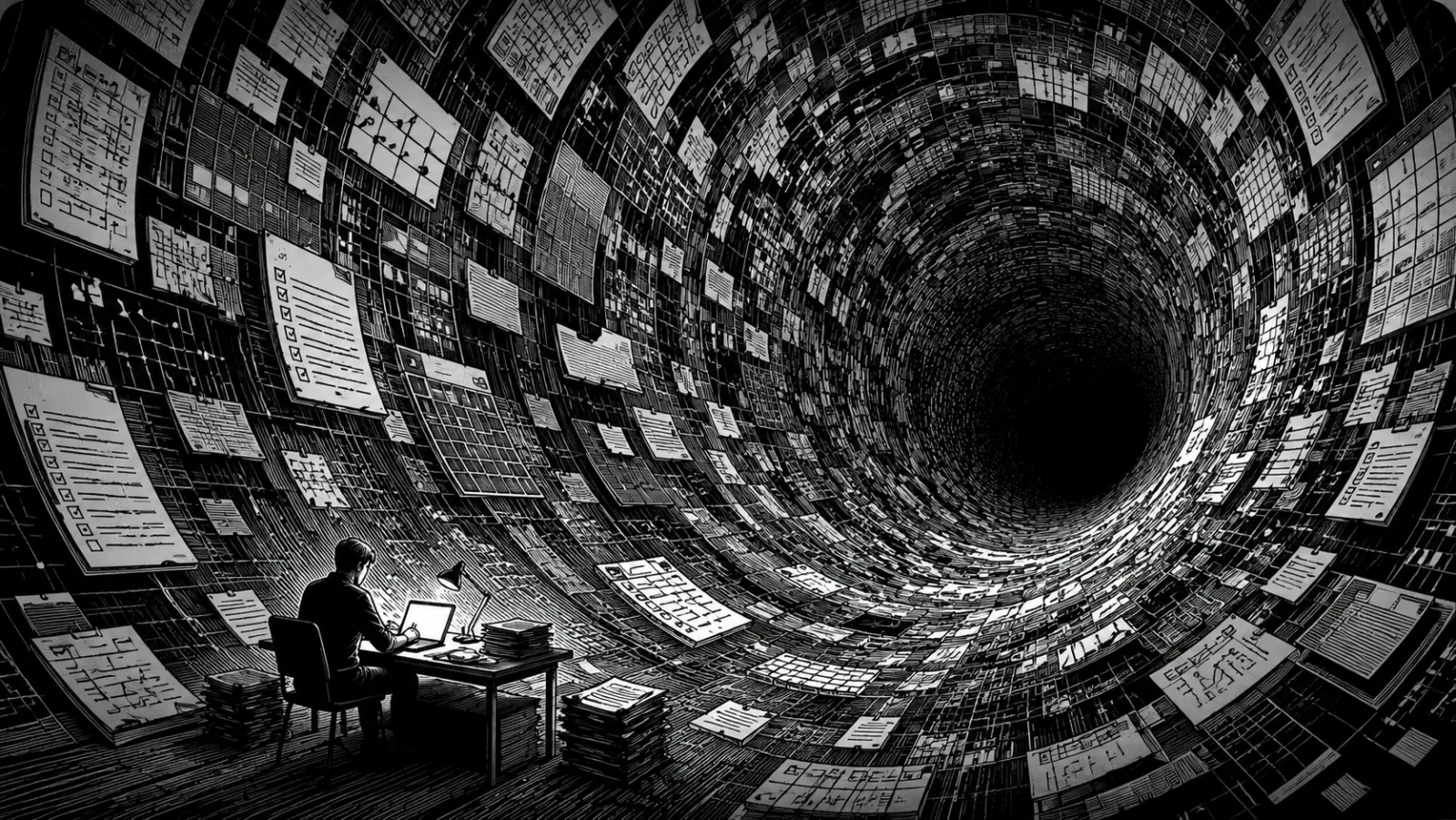
This post is mainly for people who are interested in productivity for its own sake. It won't, however, be a text about doomscrolling, deleting TikTok, or cutting down on time spent on social media.
It's about a different kind of distraction. The kind that looks like work, gives you a sense of progress, and lets you end the day convinced that you did something worthwhile.
Even if, in reality, you did nothing that mattered.
Day to day, I manage a lot of information and a lot of sources of it. I handle several inboxes, calendars, projects, and areas of work. I need a place that will help me pull that mess into one coherent whole.
At a moment like that, Notion shows up naturally.
I install the app, write the first notes, connect the calendar, add databases, and start managing projects. Views, statuses, relations, filters, and templates appear. For a while everything looks good. I get the feeling that I'm finally in control of my obligations.
Then more projects show up.
Each one needs a different approach. One needs a simple task list, another documentation, a third a schedule, and yet another a connection between notes, files, contacts, and the decisions that were made. In time, the system that was supposed to organize the work becomes a project that needs managing itself.
At this point someone will probably say that I'm using Notion wrong. That I designed the workspace badly, went overboard with databases, or didn't understand the methodology.
They may be right.
But I do know how to manage information. If, despite that, I start spending more time fixing the system than using it, the problem doesn't necessarily lie in the configuration alone.
Maybe not every organizational problem can be solved with one more view.
If not Notion, then maybe Obsidian
After a while, I start looking for something else.
Notion stops being enough, and on top of that my data sits on somebody else's servers. I'm not entirely comfortable with that. That's how I come across Obsidian.
Local files, Markdown, fast performance, and no need to build everything around a single online service. At first it seems like exactly what I needed. My knowledge is on my own disk; I can copy it, move it, and browse it without depending on one platform.
But another question shows up quickly:
How do I manage projects here?
I go to YouTube. I ask ChatGPT. I read articles. It turns out you can install a few plugins, set up templates, create a folder structure, add properties, tags, queries, and dependencies between notes.
Before long I no longer have a note-taking app. I have an environment that has to be designed, configured, and maintained.
And of course you can't forget about the "second brain."
So much has been written about this concept that it's hard to add anything new. The idea is simple: an external system is supposed to store knowledge, take load off your memory, and help you return to information when you need it.
The trouble starts when building the second brain stops supporting the first one.
I can dump hundreds of notes into Obsidian. I can build a network of links, indexes, maps of content, and mechanisms for sorting things automatically. I can also ask Claude to analyze my entire body of knowledge.
But what actually comes of it?
Often not much.
My second brain may contain thousands of properly described pieces of information, but if they don't influence my decisions, my work, and the way I think, they remain nothing more than a well-organized archive.
It runs outside my first brain.
And here comes the uncomfortable question: am I still building a knowledge system, or am I just collecting evidence that I once read something?
Organizing the work instead of doing it
I could describe more apps, but the pattern usually looks the same.
First there's a problem. Then I find a tool that's supposed to solve it. Then comes the configuration, the data migration, and the tuning of the system to the way I work. For a few days I have the feeling that everything is heading in the right direction.
After a while I notice that instead of doing the work, I'm organizing the space where I'll do it someday.
Instead of writing a text, I build a system for managing texts. Instead of starting a project, I prepare its structure. Instead of completing a task, I improve the way it's labeled. Instead of organizing a few important pieces of information, I design a place that will one day store all information.
It still looks like productivity. That's exactly why the problem is so hard to notice.
After all, I'm not sitting idle. I'm building databases, tidying notes, configuring automations, and refining views. Every one of those activities gives a sense of progress. By evening, though, it turns out that the only finished thing is a system for doing work.
That's procrastination dressed in a good interface.
We don't run from our obligations by watching videos. We run by building an environment in which, one day, we'll start working better.
Productivity can become a hobby
The most important thing I've taken from using productivity apps is the awareness of how easily you can waste time in a way that looks perfectly reasonable.
Productivity can become a hobby.
You can follow the release of one app after another, compare methods, rebuild systems, and test new processes. You can spend hours looking for the right tool even though the previous one still did its job.
The problem isn't that these apps are bad. I use them all the time myself. The problem starts when the tool stops being a means of doing the work and becomes the main object of interest.
At that point a productivity system starts to resemble a game that can't be finished. There's always a view to improve, a field to add, a structure to change, a new template to create, or data to move into the app that this time will really solve everything.
There's no moment at which the system is done.
And since it isn't done, it's easy to believe that this is precisely why we can't start the real work yet.
It's a convenient belief. The responsibility stops resting on us and starts resting on a badly configured tool.
Is productivity as addictive as social media?
I don't want to put an equals sign between work apps and TikTok or Instagram. The mechanisms and goals of those products are different.
There is, however, a similarity that can't be entirely ignored.
In both cases we can fall into a loop of small stimuli. On social media we scroll to the next piece of content. In productivity tools we tweak the next element of the system.
First we find a new template, then an app that manages tasks better, then a view that will organize projects, and finally an integration meant to connect all the earlier integrations. Every change gives a brief sense of control. It seems that this time everything will get simpler.
For a few days it actually might.
Then another problem shows up, and the answer to it is supposed to be the next change.
We don't escape action through entertainment. We escape through preparing to act.
It's a more insidious form of procrastination, because it's easy to justify to yourself. After all, we can say that we're optimizing a process, organizing knowledge, or building a system for the future.
It doesn't sound like wasting time.
And that's exactly why it can consume so much of it.
The perfect system doesn't exist
For a long time I thought I had to find one system that would combine tasks, notes, projects, calendars, mail, and knowledge storage.
Today I'm not convinced such a system should exist at all.
The more problems we try to solve with a single tool, the more complicated it becomes to use. And when a tool needs constant maintenance, it starts taking the time it was supposed to save.
Every system has a cost. We don't pay for it in money alone. We pay with attention, with the time configuration takes, with the need to keep the data tidy, and with the effort of making daily decisions.
Where do I save this piece of information? Which project does this task belong to? Should I tag it? Should I create a separate note? Should I add another field?
If a system requires answers to these questions at every step, it isn't taking load off your mind. It's becoming another source of work.
Maybe we don't need one app for everything. A calendar can hold the things that have a specific date. A task list can hold the things that need doing. Notes can serve to record information, and a project system to coordinate work that takes more than a few steps.
Not every piece of information has to go into a database. Not every note has to be linked to five others. Not every project needs its own dashboard.
Not everything has to be a system.
Some things can simply be written down, done, and closed.
A system should disappear
A good productivity system shouldn't require constant thinking about itself.
It should disappear while you work.
If every day I have to wonder where to save a piece of information, how to label a task, which project to assign it to, and which fields to fill in, the system isn't reducing the load. It's creating it.
A tool should help you move from information to a decision, and from a decision to action.
It doesn't have to store everything. It doesn't have to be perfect, and it doesn't have to handle every possible case. It has to be simple enough that I'll actually use it even when I have a lot of work, no energy, or no time to tidy up data.
A system that only works under full focus and regular maintenance isn't resilient to reality.
A good system shouldn't be impressive in a screenshot. It should work on Monday morning, when you have ten things to deal with and no appetite for managing metadata.
How do you get out of this?
I haven't found a single method that solves the problem. More and more often, though, I try to judge every change by whether it solves a real problem or merely makes my system look more refined.
I don't switch tools just because another one has a better interface. I don't build structure for problems that haven't happened yet. I don't record every piece of information solely because it might come in handy someday. I also try not to automate processes I haven't first done manually a few times.
Automating chaos doesn't remove the chaos. It just makes it run faster.
Before adding a new tool, view, or automation, it's worth answering three questions. What specific problem am I trying to solve? How often does that problem actually occur? What happens if I do nothing about it for a month?
If a concrete answer is hard to come by, we probably don't need another piece of the system.
It also helps me to separate the time set aside for maintaining tools from the time for the actual work. If, while writing an article, I notice that I'm missing a category or a view, I write the thought down and come back to it later. I don't rebuild the whole environment halfway through a task.
One question, though, remains the most important:
Will this change help me do a specific piece of work, or will it only give me the feeling that I'm preparing to do it?
The difference is small, but the consequences can be large.
Tools are still necessary
I don't want this post to be a negative judgment of Notion, Obsidian, or any other app. I use them myself and I'll keep using them.
They help store knowledge, plan projects, and organize obligations. They don't, however, automatically solve problems with priorities, decision-making, focus, or follow-through.
An app can show me a task, but it won't do it for me. It can store a note, but it won't make me understand it. It can connect information, but it won't guarantee that I'll draw conclusions from it.
Tools support the work, but they don't replace thinking and doing.
That's why I keep arriving at the conclusion that a good productivity system isn't the one that can do the most. It's the one that lets you stop thinking about the system and start the work it was built for.
Maybe the most productive thing we can do with our productivity system is, at some point, to stop developing it.